
Home Assistant voice is no longer just one device or one approach.
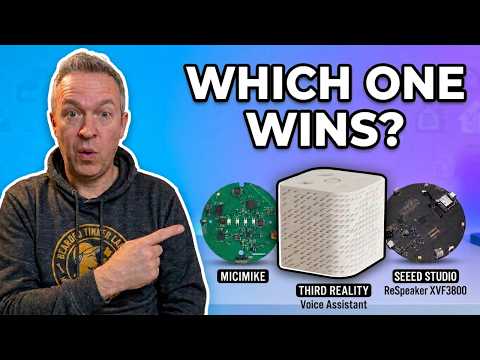
In this video, I’m starting a new series where I’ll test several very different ways of bringing voice into Home Assistant — from a ready-made voice assistant, through a brain transplant for an old Google Home Mini, all the way to a maker-focused 4-microphone platform.
This is not a laboratory benchmark. I’m interested in something much simpler: are these devices actually useful in everyday life? Can they hear me naturally? Do they sound good enough to live in a room? How much work does it take before they become usable? And, most importantly, will I still be using them after the novelty wears off?
This first video sets the stage. The individual devices will get their own deeper tests later, and this is also your chance to tell me what you want me to test while I still have everything on the bench.
🔊 Third Reality Voice & Music Assistant Dev Edition
(*)
🧠 MiciMike Home Mini DiP GEN1
🎙️ Seeed Studio ReSpeaker XVF3800 4-Mic Array + XIAO ESP32-S3
🤖 Sophia
🔉 Apollo Automation CAST-1
CAST-1 is not a voice assistant itself, but it is an interesting part of the wider Home Assistant audio, casting and distributed-speaker ecosystem.
Chapters
00:00 – Why I’m Doing This Series
01:51 – Same Goal, Three Very Different Paths
04:30 – What Do I Actually Want to Test?
06:40 – The Real Test Is Not a Benchmark
07:55 – Two Wake Words, Two Brains
08:53 – This Is Where You Come In
If you know of another ready-made Home Assistant voice assistant or smart speaker that I should look at, let me know in the comments. I’m especially interested in devices that are already reasonably complete products rather than another development board that technically becomes a voice assistant after three weekends of work.
And if there is a specific real-world test you want to see — background noise, music playing, wake-word reliability, external speakers, kids using it, response times, announcements, power consumption or something completely different — now is the time to suggest it.
💻 GitHub:
🛒 Bearded Tinker Shop:
❤️ Become a Channel Member:
If you find my videos useful, you can also support the channel using the Super Thanks button below the video. Every bit helps support future testing, projects and videos.
#HomeAssistant #VoiceAssistant #Assist #SmartHome #HomeAutomation

This is the start of the series, not the final showdown. 🙂
I already have a list of tests for Third Reality, MiciMike Home Mini DiP GEN1 and Seeed Studio ReSpeaker XVF3800, but I’m still actively testing all three.
So tell me what you want to see:
background noise, music already playing, wake-word reliability, external speakers, kids using it, announcements, response delays, power consumption, long-term reliability… or something I have not thought of yet.
And one more thing: if you know of another reasonably complete Home Assistant voice assistant / smart speaker that I should look at, drop the name below. I would love to see what else is out there in the wild while this series is still running.
One thing worth covering in the series: the Voice PE can run a custom wake word if you adopt it in ESPHome and train a microWakeWord model. I trained one for my own word. The catch was false wakes on words that sound similar, like “security,” because the training voices are all synthetic. Took a few rounds to get it solid.
I also want you to add EchoMuse to this testing series. I believe it is the cheapest way to build a HA voice assistant. Echo Dot 2nd version is only 20 dollars on ebay shipping is included. Can you buy one so that you can compare? Thanks so much and forgive me being so selfish.
That stupid mini mic board kit costs more than the goddamn Google speaker did brand new
I’m confused 😂
Came to learn about voice assistant, but got a lot of unnecessary talk, which could have been a 4 min video 😅