
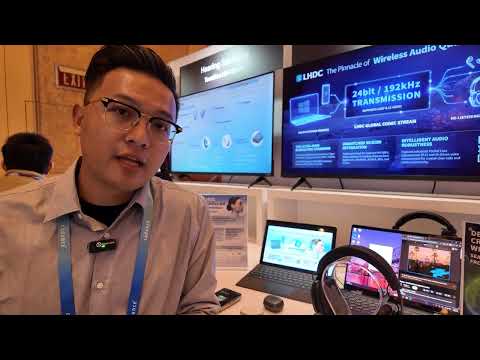
Experience the future of wireless sound. Discover how the LHDC (Low Latency High-Definition Audio Codec) is standardizing 24-bit/192kHz High-Resolution Audio across Android and Windows devices.
(Expert Insights) The Technical Foundation of HiFi Audio :
In this demo, we are joined by Bal, Product Manager for LHDC. Bal shares his expertise on how the collaboration with Cadence has allowed the LHDC codec to be optimized across the entire range of Tensilica HiFi DSPs. From HiFi Mini to the advanced HiFi 5 DSP, LHDC leverages specialized instruction sets to handle massive audio data streams, ensuring elite TWS Earbud Audio Performance.
Breaking the 192kHz Barrier :
The defining feature of LHDC V5 is its support for 24-bit/192kHz High-Resolution Audio. While standard codecs are often capped, LHDC provides the highest sampling rate currently supported in the market.
To achieve this, the codec uses an intelligent bit-rate management system that maintains Wireless Stability even in high-interference environments, such as trade show floors crowded with Wi-Fi and Bluetooth signals.
Android 17 and Windows :
A major leap for Cross-Platform Audio is occurring with the release of Android 17, where LHDC has been selected as a standard codec. This ensures that a massive range of smartphones—from Samsung to Xiaomi—will support high-definition audio out of the box. Furthermore, LHDC remains the only current solution for Windows Platform Integration supporting sampling rates up to 192kHz.
The Road to Lossless Bluetooth Audio :
The newest frontier discussed by Bal is the introduction of Bluetooth Lossless Audio. By working with manufacturers like Vivo, LHDC is implementing a lossless version that delivers CD-quality audio without the data degradation typical of wireless compression.
This “Lossless” tag is now appearing directly in the device settings of modern Android phones, giving users immediate confirmation of their audio fidelity.
Video Highlights & Timestamps :
0:04 – Introduction to LHDC and Tensilica HiFi DSP Integration
0:30 – Achieving 24-bit/192kHz: The Highest Sample Rate in the Market
0:46 – Android 17 Update: Standardizing LHDC Across Major Phone Brands
1:06 – Windows Platform Support: High-Resolution Audio for Laptops
1:36 – Connectivity Logic: Maintaining Stability in Crowded Wireless Spaces
1:54 – Real-World Demo: Testing LHDC on Android and Oppo Earbuds
2:36 – The Future of Sound: Introducing LHDC Bluetooth Lossless Audio
————————————————————————————————————————————————————-
Connect with Cadence :
• YouTube:
• LinkedIn:
• Facebook:
• Twitter/X:
• Instagram:
————————————————————————————————————————————————————-
About Cadence :
Cadence is a global leader in electronic systems design, applying its Intelligent System Design™ strategy to deliver software, hardware, and IP that turn design concepts into reality.
Cadence® customers are among the world’s most innovative companies, creating breakthrough products — from chips to boards to full systems — across markets including hyperscale computing, 5G, automotive, aerospace, mobile, consumer, industrial, and healthcare.
Recognized by Fortune as one of the 100 Best Companies to Work For ten (10) consecutive years.
Learn more at
#bluetoothaudio #losslessaudio #android17 #wirelessaudio #cadence #tws #hifidsp
You need to partner with Apple or Linux…no one cares about Windows for Bluetooth audio anymore…
Wireless audio has finally caught up to the studio! 🎧
With LHDC V5 and Tensilica HiFi DSPs, we’re seeing stable 192kHz audio and the birth of true Bluetooth lossless.
Are you ready for Android 17 to make high-definition sound a standard feature?
Let’s talk about your favorite high-res setups below! 👇
The issue is most mainstream tws and wireless headphones lack a decent internal dac/amp, so lossless audio becomes a bottleneck.
So the steam is compressed between devices? Is the destination bit perfect to the original stream? I would like an option for 24bit 48khz that is bit perfect without compression. 192khz is well beyond human hearing.
0:55 *able* doesn’t mean they will unfortunately. Also LHDC omits a very important fact here, the manufacturers need to pay a royalty fee for each device.. so that’s why Samsung isn’t doing it.
Edit: You should correct your description accounting for that. You and the website that linked here misled me into believing all Android 17 phones will get it, no no no.. they won’t..